Friday, April 12, 2013

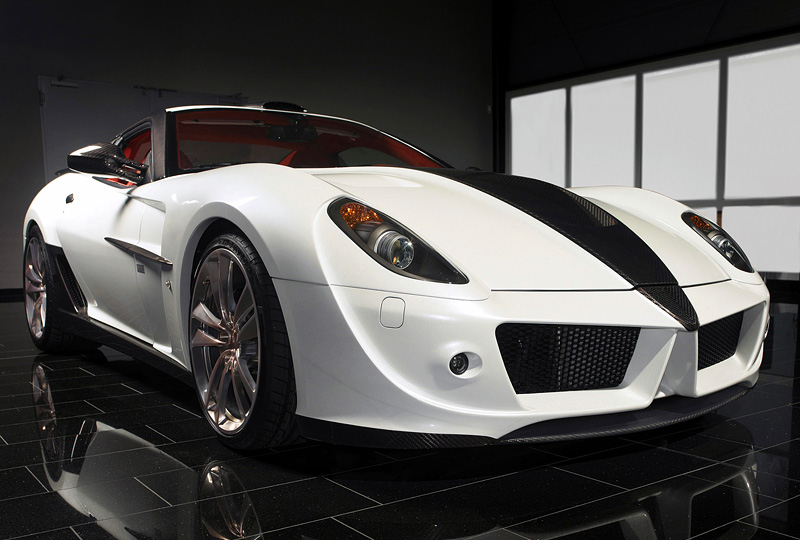
Ferrari Barchetta


A barchetta (Italian pronunciation: [barˈketta], "little boat" in Italian) was originally an Italian style of open 2-seater sports car which was built for racing. Weight and wind resistance were kept to a minimum, and any unnecessary equipment or decoration were sacrificed in order to maximize performance.
Although most barchettas were made from the late 1940s through the 1950s, the style has occasionally been revived by small-volume manufacturers and specialist builders in recent years.
Typically handmade in aluminium on a tubular frame, the classic barchetta body is devoid of bumpers or any weather equipment such as a canvas top or sidescreens, and has no provision for luggage. Some barchettas have no windscreen; others, a shallow racing-type screen or aero screen(s).
The classic barchetta either had no doors, in which case entry and exit entailed stepping over the side of the car, or very small doors without exterior handles.


Giovanni Canestrini, when editor of La Gazzetta dello Sport, a popular Italian sporting newspaper, was the very first to bestow the sobriquet "barchetta" on a car, using it to describe the new Ferrari 166MM displayed at the 1948 Turin Auto Show. The name has been associated with the model ever since.
The MM in the car’s designation stood for Mille Miglia, the race it won in 1948 and 1949. In 1949 the 166MM barchetta also won the 24 Hours of Le Mans (driven by Luigi Chinetti and Lord Selsdon) and the Targa Florio (with Clemente Biondetti and Igor Troubetzkoy), the only car ever to win all three races in the same year. It also won the 1949 Spa 24 Hours. The car’s unadorned, lightweight aluminium body was designed by Carrozzeria Touring’s head of design, Carlo Felice Bianchi Anderloni.[citation needed]
Motor Trend Classic rated the 166MM barchetta sixth out of the ten "greatest Ferraris of all time".


The OSCA MT4,a 1452 cc, 130 bhp (97 kW) barchetta made by the Maserati brothers, was for eight years the most successful under-1500 cc sports racing car in the world.
Other, even more diminutive OSCA barchettas were powered by engines of 750 cc and 850 cc.[citation needed]
Giovanni Moretti, another designer and manufacturer, also made several small barchettas in the 1950s.
The 1966 Abarth 1000SP barchetta was a successful race car, and in 2007 the car design firm Carrozzeria Bertone celebrated its 95th anniversary with the Fiat Panda-based Fiat Barchetta Bertone, an "open-topped strictly two-seater sports car that calls to mind the Italian racing cars of the 1950s. In this case, the design explicitly cites the Fiat 500 with the barchetta bodywork created by the young Nuccio Bertone in 1947 as a one-off for his personal use in races [...and] projects the concept of the barchetta, a historic icon in the legend of Italian motorsports, into the future with purposeful elegance and sophisticated irony."


Ferrari revived the name in 2001 for their 550 Pininfarina Barchetta, which marked Pininfarina’s 70th anniversary. The car was first shown at the 2001 Salon de l'Automobile and 448 examples were built. It is "[i]n many ways...the legitimate successor to such legendary open Ferraris as the 166MM..."Designed as a roadster for use on public roads and not as a full-bred racing car, the 550 Barchetta has a rudimentary convertible top "whose mechanism is said to require strength, skill, and patience."The top is intended only for emergency use in a sudden downpour and the manufacturer advises against using it at speeds above 70 miles per hour (110 km/h). The top "doesn't look as if it would survive the sacrilege of an automatic carwash." The list price of the 550 Barchetta was $245,000.

Friday, February 22, 2013

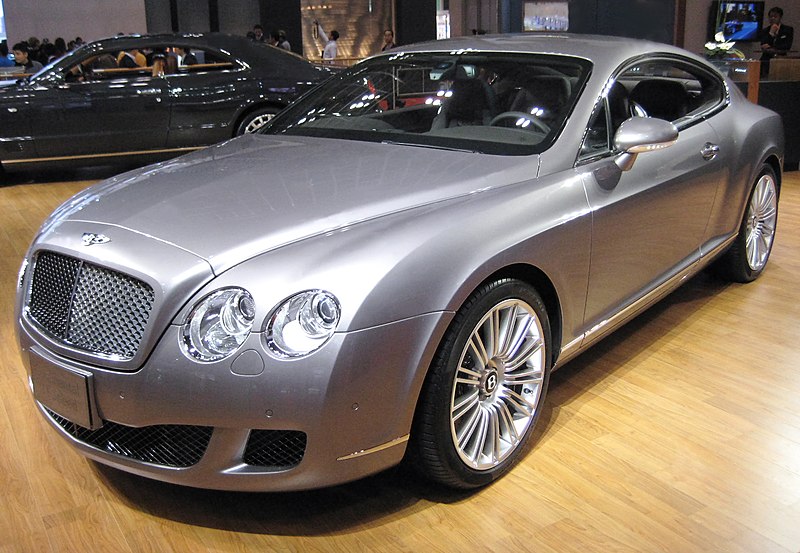
Bentley Continental SS

In February 2009, Bentley announced limited production of the Bentley Continental Supersports. The car was unveiled at the 2009 Geneva Motor Show, announced by Jay Leno, to be available in autumn 2009, while North American cars would be available by summer 2010.


The first Bentley capable of running on both petrol (gasoline) and biofuel (E85 ethanol), its 6.0 litre W12 engine was rated 630 PS (463 kW; 621 bhp) at 6,000 rpm and 800 N·m (590 lbf·ft) at 1,700-5,600 rpm - using either fuel. The car has 0 to 100 kilometres per hour (0 to 62.1 mph) acceleration of 3.9 seconds, 0 to 160 kilometres per hour (0 to 99.4 mph) acceleration of 8.9 seconds, top speed of 329 kilometres per hour (204.4 mph), making it the fastest and the most powerful production Bentley ever. The Supersports is already known as the best handling Bentley. Bentley says the supersports can deliver 1.29 g forces on a 300-foot (91 m) skid pad, as compared to its sibling the Continental GT speed which can perform up to .98 g forces on a 300-foot (91 m) skidpad.
It includes a revised ZF 6HP26A tiptronic automatic with "Quickshift" system that reduces shift times by 50%, and enables double downshifts.[citation needed] The car uses a Torsen T-3 centre differential for the 40:60 rear-biased torque split for the four-wheel drive system. Other changes include revised Continuous Damping Control (CDC),[citation needed] 20-inch lightweight alloy wheels (with increased 25 mm (1.0 in) offset on rear wheels) with 275/35 ZR20 Pirelli Ultra High Performance tires, advanced Bosch Electronic Stability Programme (ESP) with switchable Dynamic Mode, Carbon fibre-reinforced Silicon Carbide (C/SiC) ceramic disc brakes (the largest and most powerful brakes ever fitted to a production car),[citation needed] 110 kilograms (243 lb) weight saving over Continental GT Speed, automatic retractable spoiler (deploys at 80 km/h

Bentley Continental GT


The four-door Continental Flying Spur saloon was first displayed at the 2005 Geneva Motor Show. The Flying Spur utilizes most of the technical underpinnings of the Bentley Continental GT, and was introduced to European and North American markets in the summer of 2005. Together, the Bentley Continental GT and Flying Spur have boosted Bentley's annual production from around 1,000 units in 2003, to 9,200 units in 2006.[citation needed]
The Flying Spur has a 6-litre, 12-cylinder engine, configured in a W formation. Unlike a conventional 12-cylinder engine with two banks of 6 (V-12), the Continental’s 6-litre engine is configured in four banks of 3 cylinders each (W-12). This shortens the W-12 engine's length considerably, compared to a 2-bank configuration. The W-12 produces 552 bhp (412 kW; 560 PS), accelerates from 0-60 mph in 4.9 seconds, and propels the Flying Spur top speed of 194 mph (312 km/h).
One notable aspect of the Continental Flying Spur is its grille. Made to look like traditional chromed brass mesh, it is a metal-covered plastic-core. This was fitted as a safety feature; it is designed to break apart upon impact with a pedestrian.

The convertible version of the Continental GT, the Continental GTC,was first presented in September 2005, and was introduced to several world markets in the autumn of 2006. With the second generation Azure, it is the second Bentley convertible released in 2005. The roof is produced by Karmann in Osnabrück, Germany.
The GTC uses identical powertrain detail as the GT, and can accelerate from 0 to 100 kilometres per hour (0 to 62.1 mph) in 5.1 seconds.With the roof up, it will reach a top speed of 314 kilometres per hour (195.1 mph), and with the roof down 305 kilometres per hour (189.5 mph)


Ferrari 512 TR


The 512 TR sports a 4.9 litre (4,943 cc or 301.6 cu in) Ferrari Colombo 180° V-12 engine longitudinally mid mounted. Each cylinder has four valves, with forty-eight valves total, lubricated via a dry sump system, and a compression ratio of 10.00:1.These combine to provide a maximum torque of 491 newton metres (362 ft·lbf) at 5500 rpm and a maximum power of 319 kilowatts (434 PS; 428 hp) at 6750 rpm.
The Ferrari 512 TR can accelerate from 0–97 kilometres per hour (60 mph) in 4.90 seconds and on to 161 km/h (100 mph) in 10.70 seconds.It can complete a standing (from stationary) quarter mile in 13.20 seconds or a standing kilometre in 23.40 seconds.The maximum speed the 512 TR can attain is 314 kilometres per hour (195 mph)
A recall was issued in 1995, regarding fuel hose fitting issues.Over 400 models had this defect which was caused by variances in temperature and environment. Another recall was issued in relation to the passive restraint system on seat belts not functioning properly, on over 2,000 512TR's.If the restraint system suffered a mechanical or electrical failure only the lap belt would provide the occupant protection.
The 512 TR's engine was modified in many ways. Nikasil liners were added, along with a new air intake system, Bosch engine management system, larger intake valves, and a revised exhaust system. In addition to the higher peak power, the modifications delivered a more broad power curve for better acceleration.
Gearshifting effort, long a complaint about the Testarossa, was eased with a new single-plate clutch, sliding ball bearings, and better angle for the shifter. The braking system included larger front rotors and cross-drilling all around. Quicker steering, lower-profile tires, and new shock settings improved handling. Most importantly, engine and gearbox position was rethought, which improved the centre of gravity, aiding the handling and making the car less fearsome on the limit.
The interior was revised too, with the center console split from the dashboard, and the climate controls relocated. Pininfarina tweaked the body of the car to better integrate the spoilers and engine cover and update the design in line with the recently released 348.
It cost US$212,160 in 1992 with luxury items, the "gas-guzzler" taxes, and destination freight.


Ferrari Testarossa


The Ferrari Testarossa is a 12-cylinder mid-engine sports car manufactured by Ferrari, which went into production in 1984 as the successor to the Ferrari Berlinetta Boxer. The Pininfarina-designed car was originally produced from 1984 to 1991, with two model revisions following the ending of Testarossa production and the introduction of the 512 TR and F512 M which were produced from 1992 to 1996. Almost 10,000 Testarossas, 512 TRs, and F512 Ms were produced, making it one of the most common Ferrari models, despite its high price and exotic design.In 1995, the F512 M retailed for $220,000. Testarossa means "redhead" in Italian.
The Testarossa is a two-door coupe with a fixed roof that premiered at the 1984 Paris Auto Show.All versions of the Testarossa had the power fed through the wheels from a rear-mounted, five-speed manual transmission. The Rear mid-engine, rear-wheel drive layout (engine between the axles but behind the cabin) keeps the centre of gravity in the middle of the car, which increases stability and improves the car's cornering ability, and thus results in a standing weight distribution of 40% front: 60% rear.The original Testarossa was re-engineered for 1992 and released as the 512 TR, at the Los Angeles Auto Show, effectively as a completely new car,and an improved weight distribution of 41% front: 59% rear.The F512 M was introduced at the 1994 Paris Auto Show.The car dropped the TR initials and added the M which in Italian stood for modificata, or translated to modified, and was the final version of the Testarossa,and continued its predecessor's weight distribution improvement of 42% front: 58% rear.The F512 M was Ferrari's last mid-engine 12-cylinder car, apart from the F50 and Ferrari Enzo, featuring the company's last flat engine. The Testarossa was replaced in 1996 by the front-engined 550 Maranello coupe.
The vehicle should not be confused with the Ferrari TR "Testa Rossa" of the late 1950s and early 1960s, which were GT sports cars that ran in the World Sportscar Championship, including the 24 Hours of Le Mans.

The Testarossa name, which means "red head" in Italian, comes from the red-painted cam covers on the flat-12 engine.The double entendre with a red-headed woman was intentional – Ferrari and Pininfarina regularly use descriptive terms related to a female's body when describing the style of their automobiles...

Wednesday, January 30, 2013

As the Heart Hopes

It is a year dear one, since you afar
Went out beyond my yearning mortal sight­
A wondrous year! perchance in many a star
You have sojourned, or basked within the light
Of mightier suns; it may be you have trod
The glittering pathways of the Pleiades,
And through the Milky Way's white mysteries
Have walked at will, fire-shod.

You may have gazed in the immortal eyes
Of prophets and of martyrs; talked with seers
Learned in all the lore of Paradise,
The infinite wisdom of eternal years;
To you the Sons of Morning may have sung,
The impassioned strophes of their matin hymn,
For you the choirs of the seraphim
Their harpings wild out-flung.

But still I think at eve you come to me
For old, delightsome speech of eye and lip,
Deeming our mutual converse thus to be
Fairer than archangelic comradeship;
Dearer our close communings fondly given
Than all the rainbow dreams a spirit knows,
Sweeter my gathered violets than the rose
Upon the hills of heaven.

Can any exquisite, unearthly morn,
Silverly breaking o'er a starry plain,
Give to your soul the poignant pleasure born
Of virgin moon and sunset's lustrous stain
When we together watch them ? Oh, apart
A hundred universes you may roam,
But still I know­I know­your only home
Is here within my heart!

Tuesday, January 8, 2013

V8 Engine


A V8 engine is a V engine with eight cylinders mounted on the crankcase in two banks of four cylinders, in most cases set at a right angle to each other but sometimes at a narrower angle, with all eight pistons driving a common crankshaft.
In its simplest form, it is basically two straight-4 engines sharing a common crankshaft. However, this simple configuration, with a single-plane crankshaft, has the same secondary dynamic imbalance problems as two straight-4s, resulting in vibrations in large engine displacements. As a result, since the 1920s most V8s have used the somewhat more complex crossplane crankshaft with heavy counterweights to eliminate the vibrations. This results in an engine which is smoother than a V6, while being considerably less expensive than a V12 engine. Most racing V8s continue to use the single plane crankshaft because it allows faster acceleration and more efficient exhaust system designs
ferrari v8 4,300 cc

Arguably, Ferrari had their first contact with V8 power with the "inherited" Lancia D50s in 1955. Ferrari adopted the V8 configuration for themselves for racing in 1962 with the 268 SP. The first V8-powered Ferrari road car was 1974's 308 GT4, with the familiar 308 GTB following closely behind. The company continued to use this Dino V8 engine ever since with the 328, 348, and successors. Ferrari's smallest V8 (and indeed, the smallest ever) was the 2.0 L (1990 cc) unit found in the 1975 208 GT4. The company produced a slightly larger 2.0 L V8 in the 208 GTB and the 2.9 L Ferrari F40 of the 1980s. This was a turbocharged engine to reduce the road tax of the car in Italy. Automobiles with engines displacing more than 2.0 Litre were subject to a much higher tax rate. Five-valve-per-cylinder versions of Ferrari's 3.5 L and 3.6 L V8s were found in the Ferrari F355 and Ferrari 360. The old Dino V8 was retired for 2004 with the introduction of a 4.3 L V8, based on the originally Ferrari designed Maserati 4.2 V8, in the F430 and the California. And F430's successor, 458 Italia, with 4.5 V8.

Bentley engine


The Rolls-Royce and Bentley V8 still used in modern Bentleys was designed from 1952 and entered production in 1959 in the Rolls Royce Silver Cloud and Bentley S2. Following then current design practice, it featured overhead valves (OHV), a central camshaft and wedge-shaped combustion chambers. It was designed by the Rolls-Royce and Bentley Motors engineering team, led by Jack Phillips. Some of its features were inspired by the Rolls-Royce Merlin aircraft engine, including the aluminium block with wet liners, gear-driven camshaft, (initially) outboard spark-plugs and porting. Early versions were of 6.25 L (381 cu in) displacement, growing to 6.75 L (412 cu in) in the 1970s. Turbocharging in various Bentley models beginning in the 1980s led to the resurgence of the Bentley marque as the power outputs of the engine were increased in several steps to the current 500 bhp (370 kW) and 1,000 N·m (740 ft·lbf) in the 2007 model-year Bentley Arnage, while meeting all emission standards. The Bentley V8 has thus increased power and torque by more than 150% in its life. It is the highest torque V8 used in a production car. In 2007, the final components that could be traced back to the 1959 engine were replaced.
In 1936, the Standard Motor Company introduced its 'Flying Twenty V-Eight' model featuring a 2.7 L flathead V8 developing 20 RAC horsepower. It was the flagship model of the company's 'Flying Standard' range but proved unpopular as it offered little performance improvement over the normal 'Flying Twenty' model (which used a straight-6 engine) whilst costing much more to buy and suffering higher fuel consumption. The Twenty V-Eight was on sale only for the 1936 model year and fewer than 400 were sold

Ferrari 599 GTB Fiorano


The 599 GTB Fiorano (internal code F141) is an Italian gran turismo produced by Ferrari. It was the brand's two-seat flagship, replacing the 575 M Maranello in 2006 as a 2007 model, but was replaced for the 2013 model year by the F12 Berlinetta.
Styled by Pininfarina under the direction of Ferrari's Frank Stephenson, the 599 GTB debuted at the Geneva Motor Show in February 2006. It is named for its total engine displacement (5999 cc), Gran Turismo Berlinetta nature, and the Fiorano Circuit test track used by Ferrari.


The Tipo F140C 6.0 L (5934 cc) V 12 engine produces a maximum 620 PS (456 kW; 612 hp), making it the most powerful series production Ferrari road car of the time. This is one of the few engines whose output exceeds 100 hp per liter of displacement without any sort of forced-induction mechanism such as supercharging or turbocharging. Its 608 N·m (448 ft·lbf) of torque will also be a new record for Ferrari's GT cars. Most of the modifications to the engine were done to allow it to fit in the Fiorano's engine bay (the original Enzo version could be taller as it would not block forward vision due to its mid-mounted position)


On 8 April 2010, Ferrari announced official details of the 599 GTO.[6] The car is a road-going version of the 599XX and Ferrari says that the 599 GTO is their fastest road car ever, able to lap the Fiorano test circuit in 1 minute 24 seconds, one second faster than the Enzo Ferrari. Its engine produces 670 PS (493 kW; 661 bhp) at 8250 rpm, with 620 N·m (460 lb·ft) of torque at 6500 rpm.Ferrari claims the 599 GTO can reach 100 km/h (62 mph) in under 3.35 seconds and has a top speed of over 335 km/h (208 mph). At 1,605 kilograms (3,540 lb), the 599 GTO weighs almost 100 kg (220 lb) less than the standard GTB.Production is limited to 599 cars. Of these, approximately 125 were produced for the United States market. Ferrari has given only two other models the GTO designation: the 1962 250 GTO and the 1984 288 GTO.[9] Unlike the previous GTOs however, the 599 GTO was not designed for homologation in any racing series.


Monday, January 7, 2013

Porsche 911


The Porsche 911 (pronounced as Nine Eleven or German: Neunelfer) is a two-door Grand Tourer made by Porsche AG of Stuttgart, Germany. It has a distinctive design, rear-engined and with independent rear suspension, an evolution of the swing axle on the Porsche 356. Since its introduction in 1963 it has undergone continuous development, though the basic concept has remained little changed. The engine was air-cooled until the introduction of the Type 996 in 1998.
Throughout its lifetime, the 911 has been modified by private teams and by the factory itself for racing, rallying and other forms of automotive competition. It is among the most successful competition cars ever. In the mid 1970s, naturally aspirated 911 Carrera RSRs won major world championship sports car races such as Targa Florio, Daytona, Sebring and Nürburgring, even against prototypes. The 911-derived 935 turbo also won the coveted 24 Hours of Le Mans in 1979.
In the 1999 international poll for the award of Car of the Century, the 911 came fifth.It is one of two in the top five that had remained continuously in production (the original Beetle remained in production until 2003) and was until 1998 the most successful surviving application of the air- (now water-) cooled opposed rear-engine layout pioneered by its original ancestor, the Volkswagen Beetle. It is one of the oldest sports coupe nameplates still in production.

Maserati GranTurismo


The GranCabrio (GranTurismo Convertible in the U.S.) is a convertible version of GranTurismo S Automatic, equipped with a canvas roof. The GranCabrio retains the 2+2 seating configuration of the coupé GranTurismo, and is thus Maserati's first four-seater convertible.
The vehicle was unveiled at the 2009 Frankfurt Motor Show, with production beginning in 2010. The vehicle is built in the Viale Ciro Menotti Maserati factory. European sales were to begin in February 2010, with the United States receiving its first cars a month later. Planned sales for 2010 were 2,100 units, of which two thirds were intended to go stateside.
The GranCabrio is powered by the same 4.7-litre V8 engine (440 PS/324 kW; 434 bhp at 7,000 rpm, 490 N·m/361 lb·ft at 4,750 rpm) that is fitted to the GranTurismo S Automatic.

At the 2011 Geneva Motor Show Maserati unveiled a new version of the GranCabrio, with an enhanced level of performance and handling. This version also has the 4.7-litre V8, coupled with the ZF six-speed automatic transmission and fitted with the slightly uprated 450 PS/331 kW; 444 bhp version of the V8 engine, with 510 N·m (380 lb·ft) torque.To hint at the car's more sporting nature, the headlights have black surrounds and other details such as the bars in the grille are also finished in black. There are also larger sideskirts as well as tiny winglets on the lower front corners.
[edit]GranCabrio Fendi (2011-)
It is a version of GranCabrio designed by Silvia Venturini Fendi.
The vehicle was unveiled in 2011 Frankfurt Motor Show


Pagani Zonda


The Pagani Zonda is a sports car built by the Italian manufacturer Pagani. It debuted in 1999, and production ended in 2011, with two special edition cars, the Zonda 760RS and the Zonda 760LH, being produced in 2012. As of June 2009, 206 Zondas had been built, including test mules. Both 2-seat coupe and convertible versions have been produced. Construction is mainly of carbon fiber.
Some of the early Zonda engineering was done by Formula One champion Juan Manuel Fangio. The car was originally to be named the "Fangio F1" after him but, following his death in 1995, it was renamed for an air current above Argentina
Bodywork
In addition to the wheelbase increase (47 mm), overall length has increased by 394 mm (15.5 in) and track by 50 mm (2.0 in). The bodywork and aerodynamics have been altered to offer maximum downforce, featuring a longer front bonnet with flaps, a closed underbody and a new rear overhang with adjustable rear wing and race-derived diffuser. These are intended to translate into increased aerodynamic efficiency and downforce for maximum cornering speed. It is also noted that the car's new rear bodywork is minimal in the extreme, being composed mostly of vent. This is thought to be symptomatic of the need to keep the engine cool enough, even under hard track use. Again, this is similar to the gutted bodywork of the Ferrari FXX

Evoluzione.
Output has increased to 750 PS (552 kW; 740 hp) at 8500 rpm and 710 N·m (524 lb·ft) of torque. A lightweight carbon fibre high performance intake system, racing multiple disc centered clutch and Formula One-style exhaust system, hydroformed in Inconel 625 and ceramic coated for optimal heat dissipation, have been added. The AMG-built engine is mated to a 6-speed longitudinally-mounted manual sequential synchronized gearbox.
Interior
The car's interior is spartan reflecting the car's racetrack aspirations and intended home, and features bespoke seats, customized to the driver to offer maximum support. As before, the Digitek instrumentation provides essential information and the sophisticated telemetry allows a variety of sensors to monitor numerous aspects of the car.

Bugatti Veyron EB 16.4


The Bugatti Veyron EB 16.4 is a mid-engined grand touring car, designed and developed by the Volkswagen Group and manufactured in Molsheim, France by Bugatti Automobiles S.A.S.
The Super Sport version of the Veyron is the fastest street-legal production car in the world, with a top speed of 431.072 km/h (267.856 mph).The original version has a top speed of 408.47 km/h (253.81 mph). It was named Car of the Decade (2000–2009) by the BBC television programme Top Gear. The standard Veyron won Top Gear's Best Car Driven All Year award in 2005.
The Veyron's chief designer was Hartmut Warkuss, and the exterior was designed by Jozef Kabaň of Volkswagen, with much of the engineering work being conducted under the guidance of engineering chief Wolfgang Schreiber. Though commissioned by Volkswagen, this car is only sold through the Bugatti manufacturers and cannot be found at any Volkswagen dealer.
A number of special variants have been produced, including two targa tops. In December 2010, Bugatti began offering prospective buyers the ability to customize exterior and interiors colours by using the Veyron 16.4 Configurator application on the marque's official website.
In 1998, the Volkswagen Group purchased the trademark rights on the former car manufacturer Bugatti in order to revive the brand. Starting with the Bugatti EB118, they presented at various international auto shows a total of four 18-cylinder concept cars. At the 1999 Tokyo Motor Show, the first study of the Veyron was presented. At the time the name of the concept car was "Bugatti Veyron EB 18.4" and it was equipped with a 18-cylinder engine instead of the 16-cylinder engine of the production version. While the three previous prototypes had been styled by Giugiaro, the Veyron was designed by the Volkswagen stylists.
The decision to start production of the car was taken by the Volkswagen Group in 2001. The first roadworthy prototype was completed in August 2003. It is identical except for a few details to the later series variant. In the development to series production, however, considerable technical problems had to be addressed, so that the start of production was delayed repeatedly, until September 2005.

Aston Martin DB9


The Aston Martin DB9 is a GT sports car launched by Aston Martin in 2004.
The DB9 is the first model to be built at Aston Martin's Gaydon facility in Warwickshire, England. The moniker "DB" stems from the initials of David Brown, the owner of Aston Martin for a significant part of its history. The DB9, which was designed by Ian Callum and finished by his successor, Henrik Fisker, superseded the now-discontinued Aston Martin DB7 (also by Callum) which started production in 1994.
The Aston Martin DB9 comes in two variants; the coupé and 'Volante' convertible, each producing 470 bhp (350 kW; 477 PS) from a 6.0L V12 engine, originally taken from its sister car the V12 Vanquish. In fact, this V12 engine is why Aston Martin did not call the car the DB8, which could suggest that it has only a V8 engine.One report states that Aston Martin believed that this car was such a huge leap from the Jaguar XJ-S based DB7 that it named it DB9 instead of DB8, which they thought would indicate a gradual evolution.The Gaydon facility's production capacity for the DB9 could allow for approximately five thousand units per year, which is roughly the same production volume as other esteemed sports cars, in particular the Ferrari F430 and Porsche 911 Turbo. The DB9, however, is more often compared against other competitors in its segment: the Ian Callum designed Jaguar XKR, the Volkswagen-produced Bentley Continental GT, the ten-cylinder powered BMW M6, and the AMG variants of the Mercedes-Benz SL. Traditionally being a maker of more exclusive automobiles, CEO Dr. Ulrich Bez has stated that production numbers of the DB9 will be slightly higher than previous models.


The DB9 is the first Aston Martin model to be designed and developed on Ford's aluminium VH (vertical/horizontal) platform which also underpins Aston Martin's flagship DBS. The body structure is composed of aluminium and composites melded together by mechanically fixed self-piercing rivets and robotic assisted adhesive bonding techniques.The innovative bonded aluminium structure possesses more than double the torsional rigidity of its predecessor's, despite being 25 percent lighter.[4] Aston Martin's engineers designed the quad-cam, 48-valve engine for the V12 Vanquish in collaboration with Ford's Research and Vehicle Technology team (RVT) and were able to reduce its weight by 11.8 kg (26 lb) for use in the DB9.

Last Memories !

Many day have passed,and all i do is just study and study harder for the national examination.And finally the day is coming,the last day of the national examination and it feels like "damnnnnnn,finally free from jail",hahahah.and then me and my friends are planning what're we gonna do after this exam.and then we're planning to go to the sea after the exam.and the bell is ring as the student's started to leave its paperwork.My house is just 5 miles from the school,so me and my friend're walking to my apartement.When i got home,i threw my bag and change my own clothes as fast as hell  :P.and finally we're ready refresh our mind by seeing sea scenery.But,we think its better to go there without transportation,so we're going there by foot.Hell it's so damn hot,but we're still laughing down the street.and finnaly we're arrived at the sea,me and Fajrin are running like a kid who's craving with ice cream to the swing.
I was like "Look!the ice cream van is coming",he was like "Bring It On!"
We both singing and laughing so damn loud while swinging. This is what happened everytime we laugh and sing so hard while swinging :P

And we jumped together while swinging so hard,and go the shore.And suddenly there's a green weird thing in my back,and then i realize there're a lot of seaweed near the shore.But i'm wondering who in the world's putting this seaweed in my back,and dang!!it's edi,he's the one who's putting these seaweed.And the war of seaweed is begun because of my revenge to him,and yeah Great! we're wet after the war -.- .So while drying up my clothes,suddenly i see a black car is suddenly stop,i'm just wondering who the hell is that and one of my friend shout "Look ajis beiber is coming",he said that there's something to take care of.While drying those clothes,i gaze up the bright sky and listen to the music,still remember what song that i use to heard that time,and it's the most memorial song i've ever heard "Everything Changes" by Staind,and that time i'm just thinking what if everything's really change?And yea i admit now everything's change.ah just dont compare me with my past,because im not that person anymore .Just leave the memories alone.  i play football after my clothes is dry.And then i realize i forgot to bring my wallet and havent eat lunch yet,one word i said that time "Perfect" straving to death hahhahah.And one of my friend's offering me some money for a treat in a perfect timing,because the food stall is just came in,coincidence worth it :)) .We're havin' fun and enjoy a beautiful sea scenery.Its afternoon already,so we decided to get home.while walking together,im not sure if there's any sign of  "no trespassing" the only thing that i remember is just a few block of stone is blocking these street.One of my friend said "this place looks great for us to play football" and kick the ball literally without thinking,suddenly there's 2 army who's walking like a juggernaut,one of em is holding an ak-47 if im not mistaken and the other one is unarmed.And then one of the army's shouting "Ta'al Ya Kalb",then i look to the apartement windows,there's 1 army who's laughing at us but we're just freak out,forget about the ball and run outta there.And there you go !while running out like a freak my left foot is cramp i was like "oh god im gonna dieee ",and still laugh so hard after out of there.After a long walk,we take a rest at the TOYS 'R' US and looking around the store,we sure really are tired.My father is on his night shift,so he cant pick me up because i'm already tired to walk home.While my friends are all tired too outside the toys r us,than we found a unexpected thing.Its brand's Ultra and have a strawberry flavour ,damn disgusting =)) .One of my friend father's arrive and give us a ride to school.Finally arrive,and i got home to get money and out again to the Shawarma Restaurant.After eat some of sandwiches,it's maghrib so the restaurant is closed and we're going to malik house to pray maghrib and play Call Of Duty : Black Ops online or coop.Many hours have passed it's 10 pm already without realizing it,so it's the time to say goodbye.When i got home,just straight to take a bath,pray isya,eat pizza!my father bring after his busy night shift,goes to the balcony and look up at the bright moon and smile,idk why my lips is just moving by itself and whispering to my self "Who knows what's going to be happen next,just smile because today's worth it"  :)

My favourite car of all time,Ferrari 458 Italia


In Ferrari's first official announcement of the car, the 458 Italia was described as the successor to the F430 but arising from an entirely new design, incorporating technologies developed from the company's experience in Formula 1.
Engine
The 458 Italia is powered by a 4.5 L (270 cu in) V8 engine derived from a shared Ferrari/Maserati design, producing 570 PS (419 kW; 562 hp) at 9,000 rpm (redline) and 540 N·m (398 lb·ft) at 6,000 rpm with 80% torque available at 3,250 rpm. The engine features direct fuel injection, which is a first for Ferrari mid-engine setups in its road cars.
Transmission
The only transmission available on the 458 is a dual-clutch 7-speed GETRAG gearbox, in a different state of tune shared with the Mercedes-Benz SLS AMG.There is no traditional manual option, making this the fourth road-car after the Enzo, Challenge Stradale and 430 Scuderia not to be offered with Ferrari's classic gated manual. It is the first mainstream model to not be offered with a manual transmission.


  • Production            :       2009-present
  • Model years            :      2010-present
  • Assembly                    :       Maranello, Italy
  • Predecessor            :       Ferrari F430
  • Body style            :       2-seat Berlinetta 2-seat Spider
  • Layout                    :       Rear mid-engine, rear-wheel drive
  • Engine                    :      4.5 L V8
  • Transmission            :       7-speed dual-clutch
  • Wheelbase                  :       2,650 mm (104.3 in)[1]
  • Length                    :       4,527 mm (178.2 in)[1]
  • Width                    :       1,937 mm (76.3 in)[1]
  • Height                    :       1,213 mm (47.8 in)[1]
  • Curb weight            :       1,485 kg (3,274 lb)
  • Designer(s)            :       Pininfarina 
Magnificent engine


Interior


Audi R8


The Audi R8(Typ 42)is a mid-engine, 2-seater sports car,which uses Audi's trademark quattro permanent all-wheel drive system.It was introduced by the German automaker Audi AG in 2006.
The car was exclusively designed, developed, and manufactured by Audi AG's high performance private subsidiary company, quattro GmbH, and is based on the Lamborghini Gallardo platform.The fundamental construction of the R8 is based on the Audi Space Frame,[4] and uses an aluminium monocoque which is built around space frame principles. The car is built by quattro GmbH in a newly renovated factory at Audi's 'aluminium site' at Neckarsulm in Germany.
In 2005, Audi announced that the name of the successful Audi R8 race car would be used for a new road car in 2007, the Audi R8, based on the Audi Le Mans quattro concept car, appearing at the 2003 International Geneva Motor Show, and 2003 Frankfurt International Motor Show. The R8 road car was officially launched at the Paris Auto Show on 30 September 2006. There was some confusion with the name, which the car shares with the 24 Hours of Le Mans winning R8 Le Mans Prototype (LMP). 6-time 24 Hours of Le Mans winner Jacky Ickx described the R8 as "the best handling road car today".The Audi R8 is used as a safety car in Deutsche Tourenwagen Masters and British Superbike Championship racing series.

The Garden of Death

Weak but alive
dying yet still alive
huge eyes
round like golf balls
white as bones
Bony framed
fleshless
Pus in orifices
worms
teeth, white teeth
skull and bones.
Am sorry for life
Oh this pain deeper than
Only death can save
My friend, I am sorry
That you pain
When you sleep, wake
Pain, blindness
Damn anguish – no thoughts emerge
When engulfed by pain
Such heart is dead
Am sorry;
Oh this life! A taboo
You will die so
Potstones thrown
In the garden of death.
The nurse is no artist
A greater artist has shown the nurse
An art of degeneration
A human form sculptured
By an ailment of our time
A thousand diseases in one.
And then these sufferings
There will be no heaven here…
Can’t eat – wounds in mouth
Cant pee – balls on fire
Weak and dizzy
As thin as bones – is bones
Skin and foul air
Do not pity-
There will be no heaven here
A body ravaged beyond ...
When looking for hell
You will find it here.

The Worlds in this world

Doors were left open in heaven again:
drafts wheeze, clouds wrap their ripped pages
around roofs and trees. Like wet flags, shutters
flap and fold. Even light is blown out of town,
its last angles caught in sopped
newspaper wings and billowing plastic —
all this in one American street.
Elsewhere, somewhere, a tide
recedes, incense is lit, an infant
sucks from a nipple, a grenade
shrieks, a man buys his first cane.
Think of it: the worlds in this world.


Yesterday, while a Chinese woman took
hours to sew seven silk stitches into a tapestry
started generations ago, guards took only
seconds to mop up a cannibal’s brain from the floor
of a Wisconsin jail, while the man who bashed
the killer’s head found no place to hide,
and sat sobbing for his mother in a shower stall —
the worlds in this world.

Or say, one year — say 1916:
while my grandfather, a prisoner of war
in Holland, sewed perfect, eighteen-buttoned
booties for his wife with the skin of a dead
dog found in a trench; shrapnel slit
Apollinaire's skull, Jesuits brandished
crucifixes in Ouagadougou, and the Parthenon
was already in ruins.
That year, thousands and thousands of Jews
from the Holocaust were already — were
still ¬— busy living their lives;
while gnawed by self-doubt, Rilke couldn’t

write a line for weeks inVienna’s Victorgasse,
and fishermen drowned off Finnish coasts,
and lovers kissed for the very first time,
while in Kashmir an old woman fell asleep,
her cheek on her good husband's belly.

And all along that year the winds
kept blowing as they do today, above oceans
and steeples, and this one speck of dust
was lifted from somewhere to land exactly
here, on my desk, and will lift again — into
the worlds in this world.

Say now, at this instant:
one thornless rose opens in a blue jar above
that speck, but you — reading this — know
nothing of how it came to flower here, and I
nothing of who bred it, or where, nothing
of my son and daughter’s fate, of what grows
in your garden or behind the walls of your chest:
is it longing? Fear? Will it matter?

Listen to that wind, listen to it ranting
The doors of heaven never close,
that’s the Curse, that’s the Miracle.

Had I presumed to hope

Had I presumed to hope --
The loss had been to Me
A Value -- for the Greatness' Sake --
As Giants -- gone away --

Had I presumed to gain
A Favor so remote --
The failure but confirm the Grace
In further Infinite --

'Tis failure -- not of Hope --
But Confident Despair --
Advancing on Celestial Lists --
With faint -- Terrestial power --

'Tis Honor -- though I die --
For That no Man obtain
Till He be justified by Death --
This -- is the Second Gain --

Lively Hope and Gracious Fear

I was a grovelling creature once,
And basely cleaved to earth:
I wanted spirit to renounce
The clod that gave me birth.

But God hath breathed upon a worm,
And sent me from above
Wings such as clothe an angel's form,
The wings of joy and love.

With these to Pisgah's top I fly
And there delighted stand,
To view, beneath a shining sky,
The spacious promised land.

The Lord of all the vast domain
Has promised it to me,
The length and breadth of all the plain
As far as faith can see.

How glorious is my privilege!
To Thee for help I call;
I stand upon a mountain's edge,
O save me, lest I fall!

Though much exalted in the Lord,
My strength is not my own;
Then let me tremble at His word,
And none shall cast me down.